
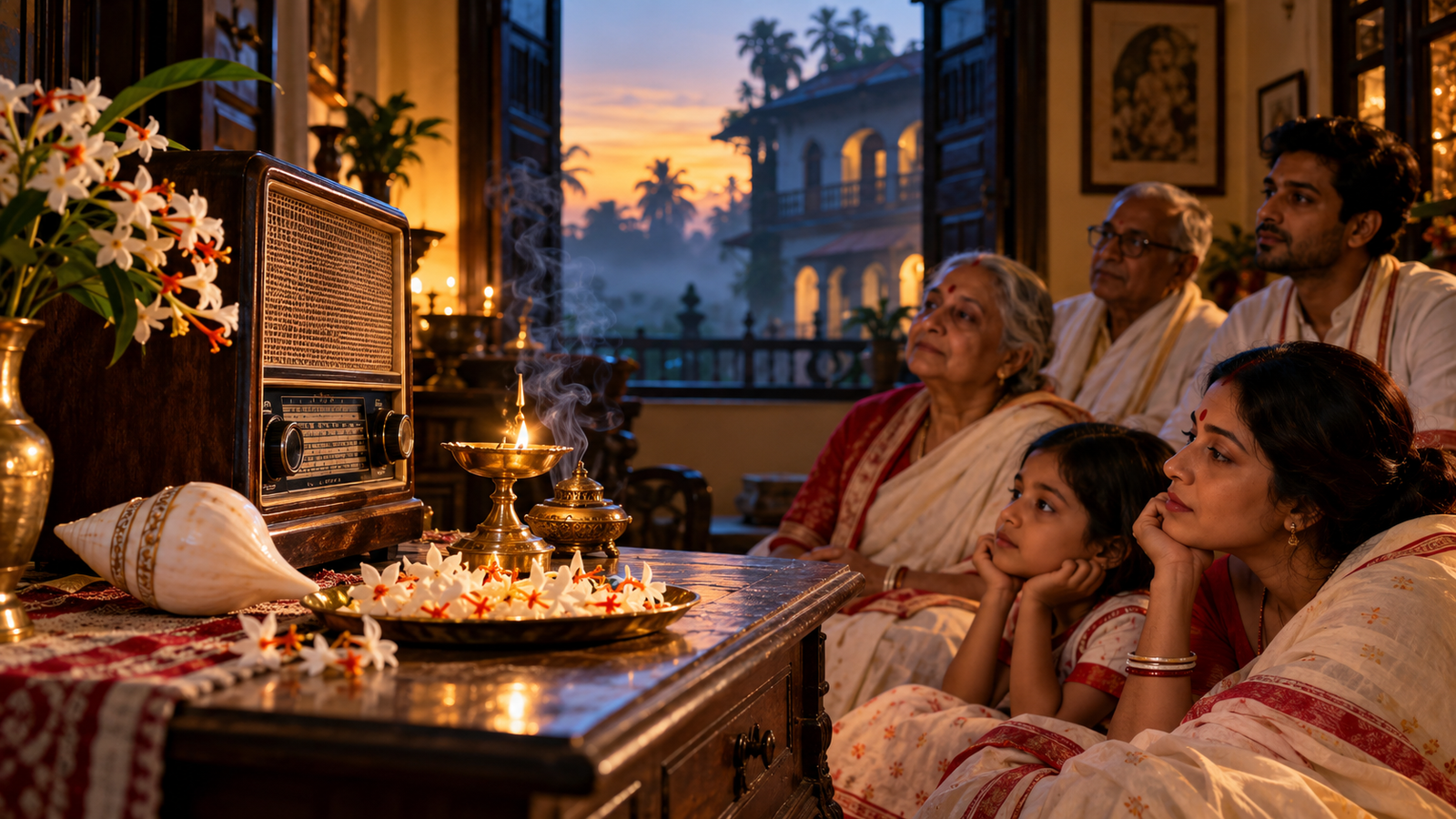
Mahalaya is not merely a date on the Bengali calendar. It is a sound, a feeling, a memory and an emotion that connects generations of Bengalis to their roots. For countless Bengali households, the arrival of Mahalaya means waking up before sunrise, listening to the resonant voice of Birendra Krishna Bhadra, hearing the sacred verses of Mahishasuramardini, and feeling that Durga Puja is finally approaching.
The tradition has survived changing lifestyles, modern technology and generations of listeners. Whether the broadcast comes from an old radio, a television, a mobile phone or a streaming platform, the moment carries a familiar magic: the story of Goddess Durga’s victory over Mahishasura begins to unfold, and the festive spirit awakens.
But behind this beloved ritual lies a fascinating story. Who created the legendary Mahalaya broadcast? Who sang its unforgettable songs? Why is Mahalaya associated with the invocation of Goddess Durga? And how did a radio programme become one of the most enduring cultural traditions in Bengal?
This article explores the mythology, history, music, artists and emotional significance of Mahalaya, explaining why this pre-dawn ritual continues to hold a special place in Bengali homes.
Table of Contents
Mahalaya: The Story, Songs and Timeless Tradition of Every Bengali Household
Introduction
There is a particular morning in Bengal when time seems to stand still. Before the first rays of sunlight touch the streets, before the neighbourhood comes alive and before the familiar sounds of daily life begin, thousands of Bengali households awaken to the same experience. A radio is switched on. A conch shell may sound in the distance. Somewhere, an elderly family member begins preparing for a ritual, while the younger members of the family gather around a familiar voice.
That morning is Mahalaya.
For generations, Mahalaya has marked the emotional beginning of the Durga Puja season for Bengalis. It brings with it the fragrance of shiuli flowers, the coolness of early autumn, memories of childhood and the unmistakable sound of Mahishasuramardini. At the centre of this experience is the extraordinary voice of Birendra Krishna Bhadra, whose recitation has become almost inseparable from the festival itself.
Yet Mahalaya is much more than a nostalgic radio tradition. It connects Hindu religious beliefs, the mythology of Goddess Durga, the remembrance of ancestors, Bengali music and the evolution of broadcasting in India. The celebrated programme combines Sanskrit verses, devotional songs, dramatic narration and classical musical arrangements to tell the story of the Goddess’s battle against the demon Mahishasura. Its enduring popularity is documented in accounts of the programme’s history and its place in Bengali culture.
Even in an age of smartphones and streaming services, the ritual continues. Some families listen to the original radio broadcast; others play recordings on their phones or televisions. The medium has changed, but the sentiment remains.
To understand Mahalaya is to understand a deeply personal part of Bengali identity: the moment when faith, music, memory and anticipation come together to welcome Maa Durga.
What Is Mahalaya?
Mahalaya is an important Hindu observance associated with the end of Pitru Paksha and the beginning of Devi Paksha in the traditional Bengali understanding of the Durga Puja season.
It is observed on Amavasya, the new-moon day that concludes Pitru Paksha. The occasion is associated with remembering deceased ancestors, offering prayers for their peace and preparing spiritually for the arrival of the Goddess.
In Bengal, Mahalaya has acquired an additional cultural significance. It is widely regarded as the ceremonial beginning of the countdown to Durga Puja, even though the principal days of the festival come later.
The word is commonly associated with Maha, meaning great, and alaya, meaning abode or dwelling. It is often popularly interpreted as the abode of the great divine power, although linguistic and religious interpretations can vary.
For many Bengali families, the meaning of Mahalaya is best understood through three interconnected ideas:
- Remembrance: Honouring ancestors and acknowledging the generations that came before us.
- Invocation: Welcoming the divine feminine power represented by Goddess Durga.
- Anticipation: Beginning the emotional countdown to Durga Puja, Bengal’s most celebrated annual festival.
The ritual of listening to Mahishasuramardini has become the most recognisable cultural expression of the day. However, Mahalaya itself is a religious observance, while Mahishasuramardini is the famous radio programme associated with it. The two are closely connected, but they are not the same thing.
Why Mahalaya Is Special in Every Bengali Household
The special place Mahalaya occupies in Bengali homes cannot be explained through religion alone. It is also a tradition passed down through family habits, childhood memories and shared experiences.
1. The ritual of waking up before sunrise
Traditionally, many households wake up around 4 AM to listen to the Mahalaya broadcast. The early hour contributes to the atmosphere: the outside world is still quiet, the sky is dark, and the day has not yet begun its ordinary routine.
Children who once struggled to wake up for school often remember getting out of bed willingly on Mahalaya morning. Parents and grandparents may have already tuned the radio to the appropriate station.
Today, people can listen through digital recordings and online platforms. Nevertheless, the habit of gathering before dawn remains meaningful to many families.
2. The familiar voice that signals Pujo
For countless listeners, Birendra Krishna Bhadra’s voice is not simply a narrator’s voice. It is a signal that autumn has arrived and Durga Puja is near.
The measured Sanskrit chanting, dramatic pauses and powerful delivery create a distinctive listening experience. His voice evokes a sense of continuity, linking listeners with parents, grandparents and relatives who followed the same ritual decades earlier.
This is why replacing the traditional recording has historically proved difficult. The audience is attached not only to the programme’s content but also to the precise voice and musical arrangement associated with it.
3. The fragrance of shiuli flowers
Mahalaya belongs to the sensory world of Bengali autumn.
Shiuli, also known as night-flowering jasmine or Nyctanthes arbor-tristis, blooms during the season and is strongly associated with Durga Puja. Its white petals and orange centres are often seen scattered beneath trees in the early morning.
In many homes, family members collect shiuli flowers for worship. The fragrance, combined with the sound of the radio and the cool morning air, creates a powerful association with the festival.
4. A tradition that connects generations
Grandparents may remember listening to the original radio broadcasts, parents may recall cassette players and early television broadcasts, while younger listeners may use mobile applications and streaming platforms.
Despite these differences, the central experience remains remarkably similar.
A grandmother explaining the story of Mahishasura to a grandchild, a parent preparing tea while the recitation plays, or a family listening together from different cities through a shared video call—all demonstrate how cultural practices adapt without necessarily losing their identity.
Mahalaya becomes a form of inherited memory: a tradition that people do not simply learn about but experience alongside their families.
The Religious Significance of Mahalaya
Mahalaya is associated with two important ideas in Hindu tradition: the remembrance of ancestors and the invocation of divine power.
The end of Pitru Paksha
Pitru Paksha is a period dedicated to remembering and honouring deceased ancestors. Depending on regional and family traditions, people perform Shraddha, offer prayers, and undertake Tarpan, a ritual offering of water.
Mahalaya Amavasya marks the concluding day of this ancestral observance in many Hindu traditions. The occasion is also known by names such as Sarva Pitru Amavasya in relevant ritual contexts.
The practice expresses gratitude toward one’s ancestors and recognises the relationship between present generations and those who came before them. Customs differ by family, region and religious tradition, so not every household follows identical rites.
The Beginning of Devi Paksha
In Bengal, the transition from Pitru Paksha to Devi Paksha is closely connected with the approach of Durga Puja.
The term Devi Paksha refers to the fortnight associated with the Goddess in the customary festival calendar. Mahalaya is therefore experienced as a spiritual turning point: a movement from remembrance of ancestors toward the anticipation of the divine feminine.
This transition gives the day its distinctive emotional character. It can be solemn because families remember departed relatives, yet joyful because the arrival of Maa Durga is approaching.
Is Mahalaya an auspicious or inauspicious day?
Mahalaya is sometimes misunderstood because it is associated with ancestral rites and the conclusion of Pitru Paksha.
However, it should not simply be described as an inauspicious day. Its meaning depends on the particular ritual or tradition being discussed. Remembering ancestors is considered a respectful and spiritually meaningful act in Hindu practice, while Mahalaya also carries the positive cultural significance of welcoming the Durga Puja season.
The combination of remembrance and celebration is one of the defining features of the occasion.
The Story of Goddess Durga and Mahishasura
At the heart of Mahishasuramardini lies one of Hindu mythology’s most celebrated stories: the victory of Goddess Durga over Mahishasura, a powerful demon whose arrogance threatens the cosmic order.
The story is associated with the Devi Mahatmya, a sacred text traditionally included in the Markandeya Purana. It describes the Goddess’s emergence as the combined power of the gods and her battle against forces that threaten righteousness.
The boon that made Mahishasura powerful
According to the traditional narrative, Mahishasura performed severe austerities and obtained a boon from Lord Brahma. The boon made him extraordinarily difficult to defeat, and he believed that no man or god could bring about his death. In some familiar retellings, his confidence rested on the assumption that a woman could never overpower him.
With his growing power, Mahishasura challenged the gods and sought control over heaven. The gods were unable to defeat him through their individual strength.
The creation of Goddess Durga
Faced with this threat, the gods united their divine energies. Their combined radiance gave rise to Goddess Durga, who embodied their collective strength and the power of the divine feminine.
The gods presented her with weapons and sacred attributes. Durga was depicted riding a lion or tiger, representing courage, sovereignty and the ability to confront destructive forces.
She was not created merely as another warrior. In the theological understanding of the narrative, she represented a power greater than the separate strengths of the gods who invoked her.
The battle between Durga and Mahishasura
The battle between the Goddess and Mahishasura became a struggle between divine order and destructive arrogance.
Mahishasura repeatedly changed his form, including taking the form of a buffalo. Durga confronted his different manifestations with determination and eventually defeated him.
The victory symbolises the triumph of dharma over adharma, wisdom over arrogance and righteous power over oppression.
The name Mahishasuramardini reflects this central act: the slayer or destroyer of Mahishasura.
Why this story matters during Durga Puja
The story is not only about a battle between supernatural beings. It also communicates a wider cultural message.
Durga embodies courage, protection, determination and the power to overcome seemingly impossible challenges. Her victory reminds devotees that destructive power, however formidable, is not invincible.
For Bengali households, hearing this narrative on Mahalaya morning makes the Goddess’s arrival feel immediate. The festival’s elaborate idols, devotional music and community celebrations follow a story that listeners have already encountered through the radio.
The mythology therefore provides the emotional and spiritual foundation for the celebrations that follow.
The Origin and History of Mahishasuramardini
The history of Mahishasuramardini is one of the most fascinating chapters in Indian broadcasting. It demonstrates how radio, music, literature and performance came together to create a cultural tradition that has outlived many of the technologies through which it was first experienced.
How the programme began
The programme emerged during the early development of organised radio broadcasting in Kolkata. Its creation brought together writers, musicians, performers and broadcasters who wanted to present a compelling musical narrative based on the mythology of Goddess Durga.
he programme is widely associated with 1931 as its year of origin. However, accounts of its early development distinguish between its initial conception, related experimental broadcasts and the later establishment of the Mahalaya broadcast in its familiar form.
A historical account published by Anandabazar Patrika describes an early Durga-themed production called Basanteshwari in 1932, followed by a musical presentation centred on Mahishasura’s defeat. A refined version was broadcast on Mahalaya in 1933. The programme later became known as Mahishasuramardini.
These details explain why historical sources sometimes give different dates for the programme’s beginnings. The important point is that the broadcast developed over several years rather than appearing fully formed in its present, familiar version on a single day.
From live performance to recorded tradition
In its early years, the programme was performed live. This required extensive coordination between the narrator, singers, musicians and technical staff.
The performers had to deliver the verses and songs with precision, while the broadcast team ensured that the programme moved smoothly between narration, chanting and musical passages.
The programme was recorded in 1966, after years of live performances. The recorded version subsequently became the familiar broadcast heard by generations of listeners.
Recording helped preserve a specific performance. Instead of recreating the entire production live each year, broadcasters could transmit the same celebrated rendition, allowing its musical arrangements and narration to become part of a shared cultural memory.
Why the original recording became irreplaceable
Many cultural works become popular because of their stories. Others become inseparable from the people who perform them.
Mahishasuramardini achieved both.
The mythology of Durga’s victory provided the narrative, but the particular combination of Bhadra’s voice, the singers’ performances, the music and the broadcast’s carefully constructed atmosphere gave the programme a distinct identity.
For listeners who grew up hearing it every year, even a small change could feel significant. The familiar pauses, chants and melodies became part of the ritual itself.
The programme consequently developed a rare quality: it remained a historical recording while continuing to feel like a live annual event in the lives of its listeners.
Who Was Birendra Krishna Bhadra?

Birendra Krishna Bhadra (1905–1991)
Radio broadcaster, reciter, playwright and theatre personality
Birendra Krishna Bhadra is the legendary voice most closely associated with Mahalaya. His recitation of Mahishasuramardini has become one of the most recognisable sounds of Bengali cultural life.Birendra Krishna Bhadra was born in Kolkata in 1905.
He studied at Scottish Church College and became associated with All India Radio in Kolkata during the early years of his professional career.
He was not simply a voice behind a microphone. Bhadra was also a playwright, actor, director and experienced radio personality. His familiarity with dramatic performance helped him deliver the narrative with a sense of movement and intensity.
What made his voice extraordinary?
The most striking quality of Bhadra’s performance is the balance between reverence and theatrical power.
His Sanskrit recitation is deliberate and commanding. He uses pauses, changes in emphasis and carefully controlled vocal intensity to give the verses dramatic force. Rather than sounding like a detached reading of religious material, the narration unfolds as a story.
Listeners are carried from the invocation of the Goddess to the appearance of Mahishasura and the climactic battle. The musical passages provide moments of beauty and reflection, while the recitation maintains the narrative’s momentum.
The result is a form of audio storytelling that can hold the attention of listeners even without visual accompaniment.
Was his voice recorded specifically for Mahalaya?
Bhadra’s association with the programme developed through its early productions and live performances. The familiar recording later preserved and broadcast by All India Radio became the version audiences came to identify with Mahalaya.
The recording is especially important because it allowed his performance to reach new generations long after his death on 3 November 1991.His voice now occupies a distinctive place in Bengali cultural memory. People may not know every Sanskrit verse by heart, but many recognise the opening atmosphere of the broadcast within seconds.
Who Wrote Mahishasuramardini and Composed Its Music?
The programme’s success was the result of collaboration. Three names are particularly important: Bani Kumar, Pankaj Kumar Mullick and Birendra Krishna Bhadra.
1. Bani Kumar — The scriptwriter
Bani Kumar, also known as Baidyanath Bhattacharya, is credited with writing the programme’s script. His work shaped the narrative structure, connecting sacred verses, dramatic storytelling and devotional songs into a coherent presentation.
The script transformed an established mythological story into a carefully paced radio experience.
2. Pankaj Kumar Mullick — The music director
Pankaj Kumar Mullick was a pioneering musician, composer and music director. His work helped shape the programme’s musical identity, giving the narration a rich devotional and dramatic framework.
Historical accounts also credit other musicians with composing particular songs and musical passages. It is therefore more accurate to recognise Mullick as a central musical architect rather than assume that every melody in the programme was composed by one person.
3. Birendra Krishna Bhadra — The narrator and reciter
Bhadra gave the programme its unforgettable voice. His narration and recitation of the sacred verses created the dramatic foundation around which the songs and musical passages were arranged.
His performance became so deeply associated with Mahalaya that his name is now almost synonymous with the occasion.
The programme’s identity was also shaped by the singers and instrumentalists who performed in its musical sequences. Their contribution is essential to understanding why Mahishasuramardini is more than a recitation: it is a carefully constructed musical work.
The Legendary Singers Behind Mahalaya
One common misconception is that Birendra Krishna Bhadra sang the entire Mahalaya programme. His defining contribution was narration and scriptural recitation. The musical sections feature a range of celebrated Bengali vocalists.
Over the years, the programme brought together performers from different musical backgrounds, including classical, devotional and modern Bengali music.
Some of the prominent singers associated with the programme include:
| Singer | Contribution to the tradition |
|---|---|
| Pankaj Kumar Mullick | Music direction and singing |
| Dwijen Mukhopadhyay | Celebrated Bengali singer associated with devotional and modern songs |
| Arati Mukhopadhyay | Important vocalist in the programme’s performance history |
| Supriti Ghosh | Recognised singer associated with early Mahalaya broadcasts |
| Sandhya Mukhopadhyay | Iconic Bengali vocalist associated with the programme |
| Manabendra Mukhopadhyay | Noted singer known for Bengali modern and devotional music |
| Pratima Banerjee | Prominent vocalist in the programme’s history |
| Shyamal Mitra | Celebrated singer and composer |
| Utpala Sen | Singer associated with the programme’s early performances |
| Sumitra Sen | Respected Bengali vocalist |
| Tarun Banerjee | Singer associated with the programme’s musical tradition |
| Shipra Bose | Bengali singer who contributed to the programme |
This list is not exhaustive. Historical accounts of the live programme also name Bimal Bhusan, Krishna Dasgupta, Ashima Bhattacharya and others. The precise combination of performers varied across the programme’s history.
Why the singers matter as much as the narrator
The recitation gives Mahishasuramardini its dramatic spine, but the songs give it emotional breadth.
A powerful invocation can communicate reverence. A lyrical devotional passage can express longing, surrender or joy. Classical musical phrases create transitions between scenes, while choral and instrumental elements add scale to the narrative.
The programme therefore works on several levels at once: it tells a story, offers a devotional experience and presents a musical portrait of Bengali culture.
For many listeners, a familiar melody is just as evocative as Bhadra’s voice. A few notes can bring back memories of a childhood home, a parent preparing for Pujo or a grandparent listening beside an old radio.
The Songs That Make Mahalaya Unforgettable
The songs of Mahishasuramardini are integral to its enduring appeal. They combine devotional lyrics, classical influences and Bengali musical expression to create a soundscape that is recognisable across generations.
Several musical passages are particularly associated with the broadcast.
1. “Ya Chandi”
The opening invocation, commonly identified by the phrase “Ya Chandi”, establishes the programme’s devotional atmosphere.
The Sanskrit verses praise the Goddess in her various forms and prepare listeners for the story that follows. Their rhythmic delivery and ceremonial tone make the opening especially memorable.
The chanting is not simply an introduction. It establishes the spiritual context for the entire programme.
2. “Akhil Bimane”
“Akhil Bimane” is one of the song titles associated with the musical tradition of Mahishasuramardini. Historical accounts attribute its tune to Pandit Harishchandra Bali rather than solely to Pankaj Kumar Mullick
The programme’s songs draw on a blend of devotional expression and musical composition, creating a distinctive atmosphere that differs from an ordinary sequence of standalone songs.
3. “Aloker Gaan”
“Aloker Gaan” is another musical passage associated with the broadcast. Like “Akhil Bimane”, its tune has been attributed to Harishchandra Bali in historical accounts of the programme.
The song belongs to the wider musical tapestry through which the programme expresses the arrival of divine power and the movement from darkness toward light.
4. “Shanti Dile Bhori”
“Shanti Dile Bhori” is associated with the concluding musical portion of the familiar programme. Accounts of its early musical history credit Sagir Khan with composing its tune.Its place toward the end of the broadcast helps give the experience a sense of completion after the dramatic narrative and devotional invocations.
Why these songs remain memorable
The songs endure because they are not experienced in isolation. They are embedded in an annual ritual.
A listener who hears a melody every Mahalaya morning may associate it with a particular room, the sound of rain outside, the first light of dawn or the presence of relatives who are no longer alive.
Over time, the music becomes a vessel for personal and collective memory. The listener hears a song, but also remembers a time and a place.
Copyright note for publishers: Song titles and artist credits can be included in an article, but the full lyrics, long audio excerpts and copyrighted recordings should not be reproduced without the necessary permission.
The Story Behind the 1976 Mahalaya Broadcast
One of the most remarkable episodes in the history of Mahishasuramardini took place in 1976.
By that time, the traditional broadcast had become a deeply established part of Mahalaya. Listeners expected to hear Birendra Krishna Bhadra’s familiar narration and the programme’s celebrated musical arrangement.
However, All India Radio decided to replace the traditional programme that year with a new production titled Debi Durgatiharini.
The new programme featured prominent personalities, including the celebrated Bengali actor Uttam Kumar, with music direction by Hemanta Mukherjee. It was an ambitious attempt to present the Mahalaya experience in a different form.
Yet the response from listeners was overwhelmingly unfavourable. Many people had developed such a strong emotional connection with the original programme that the replacement felt like a disruption of their tradition.
The reaction demonstrated something important about cultural heritage: audiences do not always welcome a new version of a familiar work, even when it features celebrated artists. For listeners, the original programme was not merely an entertainment broadcast. It was part of the ritual through which Durga Puja began in their homes.
According to the historical account published by Anandabazar Patrika, the traditional Mahishasuramardini was broadcast again on the day of Mahalaya in 1977, following its return to the familiar place in the annual traditionAnandabazar
The episode is now remembered as an extraordinary example of public attachment to a radio programme.
It also explains why the question of who narrates Mahalaya matters so much. A different performance may communicate the same mythology, but it cannot automatically reproduce the memories, expectations and emotions attached to the original.
For many Bengali families, Bhadra’s voice remains irreplaceable not because other artists lack talent, but because his performance has become part of their cultural inheritance
Mahalaya Rituals in Bengali Homes
Although the radio broadcast is the most widely recognised Mahalaya tradition, the day has several religious and household practices associated with it.
Customs vary from family to family. Some households observe the occasion primarily through listening to Mahishasuramardini, while others undertake ancestral rites, prayers and offerings.
1. Tarpan for ancestors
One of the significant religious observances associated with Mahalaya is Tarpan.
In this ritual, people offer water, sometimes accompanied by sesame seeds and other prescribed items, while remembering deceased ancestors. The procedure varies according to family tradition and the relevant religious practice.
For many participants, Tarpan represents gratitude and remembrance. It acknowledges that family identity extends beyond the living members of a household.
Not every Bengali family performs Tarpan personally, and the ritual is not a requirement for listening to Mahishasuramardini. It is important to distinguish the religious observance from the cultural radio tradition.
2. Listening to Mahishasuramardini
The traditional broadcast remains the defining ritual for countless households.
Families may gather around a radio or play the recording through a television, computer or smartphone. Some listen in silence, while others continue their morning preparations with the programme playing in the background.
The experience often begins with the familiar opening sounds and Bhadra’s recitation, creating an atmosphere that listeners immediately associate with Mahalaya.
3. Offering flowers and prayers
In households that follow devotional practices, flowers, incense and lamps may form part of the morning’s observances.
Shiuli flowers are particularly evocative during the autumn season. Their fragrance and appearance are closely connected with the visual and emotional atmosphere of Durga Puja.
The exact offerings and prayers depend on family custom; there is no single household routine followed by every Bengali.
4. Visiting the Ganga for ancestral rites
In Kolkata and other parts of Bengal, some people visit riverbanks to perform Tarpan. The River Ganga has a particularly important place in Hindu ritual life, although ancestral observances are not limited to one location.
These visits combine religious practice with a shared public observance. Early-morning gatherings, prayers and offerings create a solemn atmosphere.
5. Preparing for Durga Puja
Mahalaya also marks a psychological shift in the household.
The festive season begins to feel close. Families may finalise shopping, discuss plans to visit pandals, prepare their homes or arrange reunions with relatives.
For children, it can mean that new clothes, sweets, holiday outings and pandal visits are finally within reach. For adults, it may mean organising travel, meeting relatives and preparing for family celebrations.
In this way, Mahalaya links spiritual preparation with the practical excitement of the festival.
5. Preparing for Durga Puja
Mahalaya also marks a psychological shift in the household.
The festive season begins to feel close. Families may finalise shopping, discuss plans to visit pandals, prepare their homes or arrange reunions with relatives.
For children, it can mean that new clothes, sweets, holiday outings and pandal visits are finally within reach. For adults, it may mean organising travel, meeting relatives and preparing for family celebrations.
In this way, Mahalaya links spiritual preparation with the practical excitement of the festival.
Why younger generations still listen
Not every young person follows the ritual, and attitudes naturally differ. Nevertheless, many younger Bengalis encounter Mahalaya through their parents and grandparents.
Some become interested in the story of Durga. Others discover the history of Bhadra and the singers. Still others appreciate the broadcast because it offers a rare opportunity to share a tradition with older relatives.
The ritual can therefore serve as a bridge between generations, even when their everyday habits and media preferences are very different.
A tradition that is personal as well as collective
Mahalaya belongs to Bengal’s cultural history, but each listener also has a personal version of it.
For one person, it may mean a grandmother waking everyone before dawn. For another, it may recall a father carefully tuning an old radio. Someone else may remember listening from a hostel room or playing the broadcast on a phone while living far from home.
The same recording carries different memories for different people.
That is perhaps the most important reason Mahalaya has endured: it allows a shared tradition to become a deeply individual experience.
Mahalaya 2026: Date and Contemporary Relevance
Mahalaya’s date changes each year because it follows the Hindu lunar calendar rather than a fixed date in the Gregorian calendar.
In 2026, Mahalaya Amavasya falls on 10 October, according to current festival-calendar reporting. Ritual timings and observances can depend on the local calendar and location.Mahalaya
The familiar Mahalaya broadcast continues to be associated with the pre-dawn hours, traditionally around 4 AM. Listeners should check local announcements for the precise broadcast schedule and available platforms.
In contemporary households, the ritual has adapted to changing technology. Some people tune in to radio, others use television or digital recordings, and some share the broadcast with family members over video calls.
The availability of recordings has made the programme easier to access, but it has also changed the nature of listening. A live scheduled broadcast creates a sense of collective participation: everyone is hearing the same programme at approximately the same time. On-demand listening offers convenience, but the annual pre-dawn ritual retains a distinctive communal quality.
Mahalaya’s continuing relevance lies in this balance between preservation and adaptation. It does not require every listener to use the same device or follow identical household practices. What matters is the continuing connection with the story, the music and the arrival of Durga Puja.Dates of Durga Puja
Important Facts About Mahalaya
| Topic | Key information |
|---|---|
| Religious occasion | Mahalaya Amavasya |
| Cultural association | The beginning of the Durga Puja countdown |
| Famous broadcast | Mahishasuramardini |
| Broadcasting organisation | All India Radio, now associated with the Akashvani name |
| Scriptwriter | Bani Kumar |
| Principal narrator | Birendra Krishna Bhadra |
| Central musical figure | Pankaj Kumar Mullick |
| Other important musical contributor | Pandit Harishchandra Bali |
| Main mythological story | Goddess Durga’s defeat of Mahishasura |
| Traditional listening time | Around 4 AM |
| Recorded version | The familiar programme was recorded in 1966 |
| Notable broadcast episode | The replacement programme in 1976 |
| Mahalaya in 2026 | 10 October, according to current festival-calendar reporting |
Historical accounts differ in how they describe the programme’s earliest development, so the date of its initial conception should be distinguished from the later establishment of the familiar Mahalaya broadcast.
People on Whom Mahalaya Has an Impact
Mahalaya’s influence extends beyond the listeners who wake up before sunrise.
For older generations, it can be a way of preserving familiar customs and passing them on to younger family members.
For children, it offers an introduction to the mythology of Goddess Durga, Bengali devotional music and the traditions associated with autumn.
For Bengali families living outside West Bengal, the programme can help preserve a connection with home, language and family history.
For musicians and cultural historians, it represents an important example of how radio can preserve musical performance and regional cultural expression.
For contemporary audiences, Mahalaya demonstrates that cultural traditions need not disappear when technology changes. They can adapt while retaining their essential meaning.
The ritual also reminds listeners that cultural heritage is sustained through repeated participation. A tradition survives not simply because it is old, but because people continue to find meaning in it.
Things to Remember About Mahalaya
- Mahalaya is a religious observance associated with the end of Pitru Paksha and the beginning of the Durga Puja season.
- Mahishasuramardini is a radio programme, not another name for the religious date itself.
- Birendra Krishna Bhadra is best known for his narration and Sanskrit recitation.
- Bani Kumar wrote the programme’s script, while Pankaj Kumar Mullick played a central role in its music.
- The programme features several singers; it is not a solo performance by Bhadra.
- The story at the centre of the broadcast is Goddess Durga’s victory over Mahishasura.
- The programme developed through early broadcasts before becoming the familiar annual Mahalaya tradition.
- The 1976 replacement broadcast demonstrated how strongly listeners were attached to the original performance.
- Tarpan and other ancestral rites are distinct from the act of listening to the programme.
- Mahalaya traditions differ across households, regions and generations.
Frequently Asked Questions About Mahalaya
1. What is Mahalaya and why is it celebrated?
Mahalaya is a Hindu observance associated with the conclusion of Pitru Paksha and the beginning of the Durga Puja season in Bengal. It is marked by ancestral remembrance, religious observances and the famous pre-dawn broadcast of Mahishasuramardini.
2. What is the story behind Mahalaya?
The cultural significance of Mahalaya is closely connected with the story of Goddess Durga’s battle against Mahishasura. The famous radio programme narrates this mythological story through Sanskrit verses, Bengali devotional songs and dramatic narration.
3. Who sang the Mahalaya song?
There is no single singer of the entire Mahalaya programme. Several celebrated singers performed its musical sections, including Pankaj Kumar Mullick, Dwijen Mukhopadhyay, Sandhya Mukhopadhyay, Arati Mukhopadhyay and Supriti Ghosh. Birendra Krishna Bhadra is principally known for his narration and recitation.
4. Who is the voice behind Mahishasuramardini?
Birendra Krishna Bhadra is the legendary narrator whose voice is most closely associated with Mahishasuramardini. His dramatic Sanskrit recitation has become an enduring part of Bengali cultural heritage.
5. Who wrote Mahishasuramardini?
Bani Kumar, also known as Baidyanath Bhattacharya, is credited with writing the script. The programme’s development also involved several musicians, performers and broadcasters.
6. Who composed the music for Mahishasuramardini?
Pankaj Kumar Mullick was the programme’s central musical director. However, the music was a collaborative production, and historical accounts attribute certain individual melodies to other composers, including Pandit Harishchandra Bali and Sagir Khan.
7. When did Mahishasuramardini first begin broadcasting?
The programme is widely associated with 1931 as its year of origin. Its early development included related productions and broadcasts, with historical accounts identifying a Mahalaya broadcast in 1933. The familiar recorded version was made in 1966.
8. Why is Mahalaya celebrated at 4 AM?
The traditional Mahishasuramardini broadcast is associated with the pre-dawn hours, usually around 4 AM. The timing has become part of the ritual, allowing families to listen before sunrise. It is a cultural convention rather than a requirement that every Mahalaya observance take place at that exact hour.
9. Why was Uttam Kumar’s Mahalaya broadcast rejected?
In 1976, All India Radio replaced the traditional programme with Debi Durgatiharini, which included Uttam Kumar’s narration. Many listeners objected because they were deeply attached to Bhadra’s familiar voice and the original musical arrangement. The traditional programme returned to its customary place in the following year’s Mahalaya broadcast.
10. What is the difference between Mahalaya and Mahishasuramardini?
Mahalaya is a religious observance on the new-moon day associated with the conclusion of Pitru Paksha. Mahishasuramardini is the radio programme traditionally broadcast on that occasion. The programme has become so closely associated with Mahalaya that the two are sometimes used interchangeably in casual conversation.
11. Is Mahalaya a day for remembering ancestors?
Yes. Mahalaya Amavasya is associated with ancestral remembrance and Tarpan in many Hindu traditions. The precise rituals vary according to family customs, religious practice and regional traditions.
12. Why do Bengalis collect shiuli flowers during Mahalaya?
Shiuli flowers bloom during the autumn season and are strongly associated with Durga Puja. Their white petals, orange centres and delicate fragrance evoke the arrival of the festival. They are also used in devotional offerings in many households.
13. Is Mahalaya the first day of Durga Puja?
Mahalaya is widely treated as the emotional beginning of the Durga Puja countdown, but the principal days of the festival follow later. The exact calendar relationship depends on the lunar dates and the particular year’s festival schedule.
14. Can I listen to Mahishasuramardini online?
The recording is available through various radio and digital platforms, subject to current availability and distribution rights. Listeners can check official Akashvani channels and authorised music platforms for the appropriate version.
15. Why is Mahalaya important to Bengalis living abroad?
Mahalaya offers a connection with Bengali language, music, religious traditions and family memories. For Bengalis living outside India, listening to the programme can recreate a familiar ritual and strengthen their connection with home.
Conclusion: The Morning When Bengal Begins to Welcome Maa Durga
Mahalaya is one of those rare traditions that has grown beyond the limits of a religious observance to become a defining part of a community’s cultural identity. Its enduring appeal lies in the way it brings together mythology, music, memory and the emotional anticipation of Durga Puja.
The story of Goddess Durga defeating Mahishasura represents the victory of righteousness over destructive power. Through Mahishasuramardini, this ancient narrative reaches listeners in a form that is both devotional and dramatic. Bani Kumar’s script, Pankaj Kumar Mullick’s musical direction, the contributions of numerous singers and Birendra Krishna Bhadra’s extraordinary narration have together created a cultural work that continues to inspire new generations.
The history of the programme also demonstrates the importance of continuity. The reaction to the 1976 replacement broadcast revealed that listeners were attached not merely to the story but to the precise performance that had become part of their annual lives. Bhadra’s voice had acquired a significance that went far beyond broadcasting.
Today, the ritual continues in different forms. Some families gather around old radios, while others listen through smartphones and online platforms. Some observe Tarpan, others offer flowers and prayers, and many simply begin their Mahalaya morning with the familiar recitation.
What unites these different experiences is a shared feeling: the sense that something deeply familiar and cherished is returning.
Perhaps that is the real magic of Mahalaya. It allows a recording from another era to feel alive in the present. It brings grandparents and grandchildren into the same moment, connects Bengalis across continents and turns the quiet hours before sunrise into a celebration of heritage.
When Birendra Krishna Bhadra’s voice begins to echo through a Bengali household, the occasion becomes more than a broadcast. It becomes a memory being renewed, a tradition being passed on and an invitation to welcome Maa Durga once again.
For generations of Bengalis, that is when Pujo truly begins.

Being a non-native of West Bengal, it is much more evocative for us to participate in Bengali traditions.